
I am an author, feminist, brand strategist, and designer at Unbuttoned Brands. I believe your brand should look and sound as good as the impact you're making. It's why I help values-driven businesses build bold brands that feel unmistakably like YOU, because being yourself is the strategy™.
TAKE THE BRAND VIBE QUIZ 👇️
BRAND DESIGNBRAND STRATEGYBRAND VIBEBRANDINGPERSONAL BRANDINGREAL TALKHey, I'm Emily!

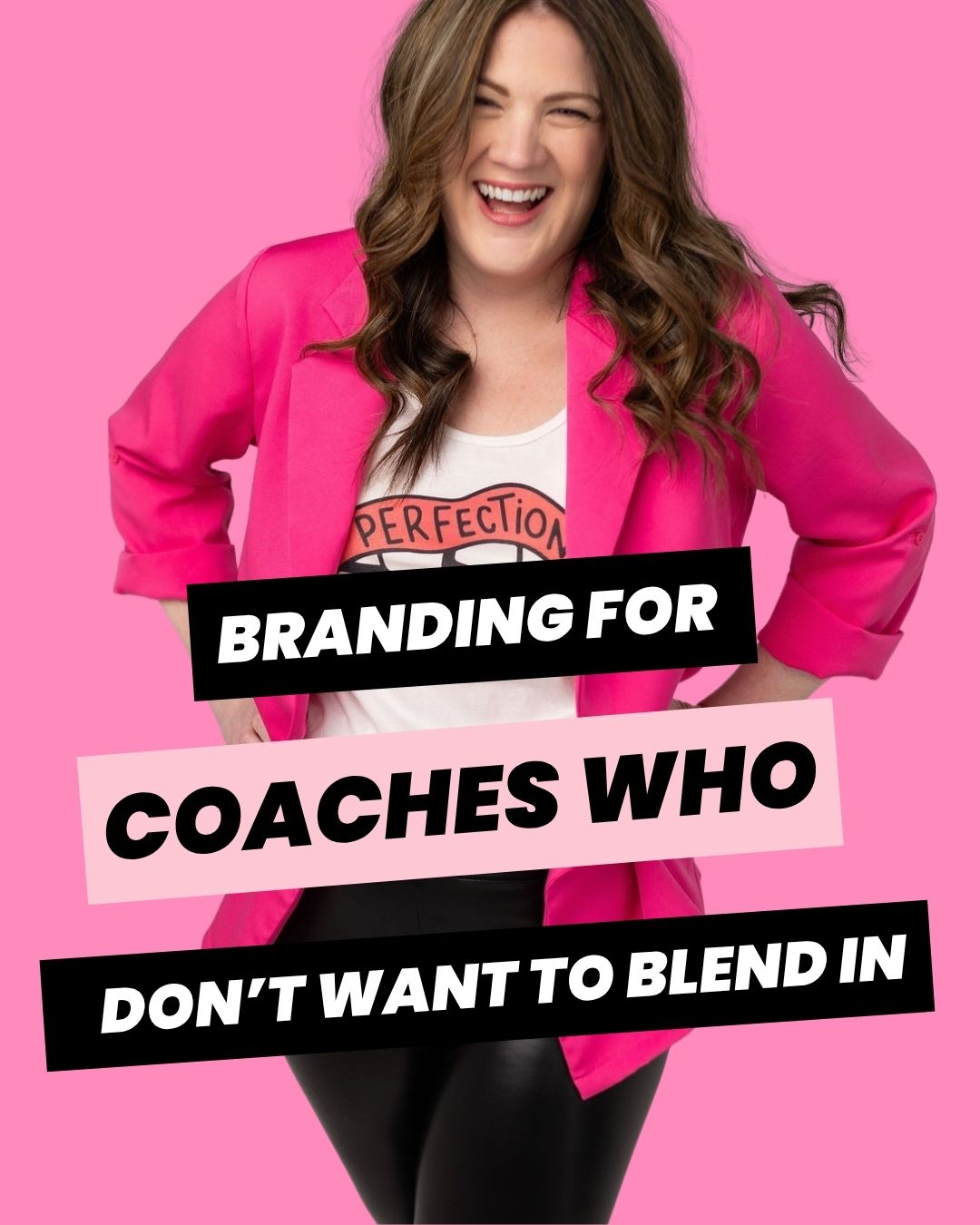
Branding for Coaches: Tips and Inspiration for NOT Blending In
LAST UPDATED: July 2026
Branding for coaches requires aligning your authentic values, unique positioning, and distinct visual identity to stand out in a crowded market without sacrificing your well-being.
If you’re a coach, you already know the market is crowded.
There are a lot of coaches out there. A lot. And if you’ve spent any time scrolling through your industry, you’ve probably noticed something: so many of them look…the same.
Same soft neutrals. Same minimalist aesthetic. Same stock photos of women laughing at laptops. Same vague taglines about “transformation” and “unlocking your potential.”
It’s a sea of sameness. And if your brand looks like everyone else’s, you’re making it really hard for your dream clients to find you, let alone choose you.
Here’s the thing though: you’re not like everyone else. Your approach is different. Your story is different. The way you work with clients is different. So why does your brand look like a template?
I’m Emily, brand strategist and brand identity designer behind Unbuttoned Brands. I specialize in branding for coaches, healers, consultants, and values-driven service providers who are done being their industry’s best-kept secret.
And in this post, I’m going to walk you through exactly what it takes to build a coaching brand that stands out…not by being louder or more performative, but by being more you.
If you’re ready to skip ahead and just get this done, explore my brand identity services or take our free branding quiz to discover your true brand vibe!
Why Is Branding for Coaches So Challenging?
Branding is hard for everyone. But branding for coaches comes with a specific set of challenges that make it trickier than most.
You are the product.
Unlike a product-based business where branding is about creating desire around something external, coaching brands are built around a person. Your personality, your philosophy, your energy, your approach—these are the offer. Which means your brand has to do something most brands don’t: it has to accurately represent a human being.
That’s intimate. It’s vulnerable. And it’s really hard to do for yourself.
Your work is nuanced and hard to explain.
Coaches do deeply layered, profoundly human work. And that kind of work resists simple taglines and tidy elevator pitches. Most branding frameworks were built for simpler offers and when you try to squeeze your work into them, it ends up sounding generic, flat, or just… not quite right.
Everyone in your industry is copying each other.
When you don’t know how to brand yourself, it’s tempting to look at what’s working for others and reverse-engineer it. The problem is that everyone is doing this at the same time, which is exactly how an entire industry ends up looking identical.
The answer isn’t to copy better. It’s to stop copying altogether.
Why Must Brand Strategy Come Before Aesthetics?
Before we talk about what your coaching brand should look like, we need to talk about what it should be built on.
This is the part most coaches skip, and it’s exactly why their branding never quite feels right.
A strong coaching brand starts with strategy: a clear understanding of your values, your voice, your differentiators, your ideal client, and the specific feeling you want your brand to evoke. The visuals…colours, fonts, logos, website design all come after that foundation is solid. Not before.
If you want to understand why this order matters so much, my post on brand strategy vs marketing strategy breaks it down in a way that actually makes sense.
The short version: your brand strategy is the foundation. Everything else is built on top of it. When you skip it, nothing holds together the way it should, no matter how beautiful your visuals are.
7 Tips for Coaching Brands That Doesn’t Blend In
1. Get specific about who you’re actually for
Generic branding tries to appeal to everyone. And brands that try to appeal to everyone end up resonating with no one.
The most magnetic coaching brands are built around a specific person…someone whose inner experience, frustrations, desires, and way of seeing the world you understand deeply and intimately.
When your brand speaks directly to that person, something shifts. Your messaging stops feeling like a pitch and starts feeling like a conversation. Your ideal client reads your website and thinks: this person gets it. This person gets me.
That feeling of being understood is one of the most powerful things a brand can create. And it only happens when you get specific.
2. Lead with your philosophy, not just your process
A lot of coaching brands describe what they do…the steps, the framework, the deliverables. And that information matters. But it’s not what makes someone choose you over someone else.
What makes someone choose you is your why. Your philosophy. Your point of view on the thing your clients are struggling with.
What do you believe that others in your industry don’t? What do you do differently, and why? What are you actively pushing back against?
Your philosophy is your differentiator. When you lead with it, you attract people who share it, and those are the clients who go all in, do the work, and get the best results.
3. Stop making yourself more “digestible”
This one is personal to me, because I see it constantly with the coaches I work with.
You’ve learned…probably from years of being told you’re “too much”…to sand down your edges. To make yourself more palatable. To communicate in a way that doesn’t alienate anyone.
And in doing so, you’ve accidentally built a brand that doesn’t feel like you.
The coaches with the most powerful brands are the ones who let themselves be specific. Specific in their opinions. Specific in their aesthetic. Specific in who they’re for and who they’re not.
Being specific will put some people off. That’s fine. Those aren’t your people. And the ones who are? They’ll feel it immediately.
4. Choose brand colours that actually reflect your energy
Your colour palette is doing more work than you think. It’s communicating your energy before a single word is read and if it doesn’t reflect who you actually are, it’s creating a disconnect that potential clients can feel even if they can’t name it.
For a deep dive on this, read my guide on how to choose brand colours that feel authentic. But the short version: stop choosing colours based on what’s trending in your industry, and start choosing them based on the feeling you want your brand to evoke and the aesthetic you’re actually drawn to.
Bold, colourful branding in a sea of beige and sage is a statement. It says: I know who I am. I’m not trying to blend in. And I’m not making myself smaller to make you more comfortable.
That kind of brand attracts the clients who are ready for exactly that energy.
5. Write like a human being, not a brand
So much coaching copy sounds the same because it’s written to sound professional rather than to sound true.
It’s polished and vague and carefully inoffensive. And it puts people to sleep.
Your voice…your actual, real, this-is-how-I-talk voice…is one of your most powerful brand assets. When your copy sounds like you, it builds trust in a way that polished, professional copy never can. People read it and feel like they already know you. Like the conversation has already started.
This doesn’t mean being casual for the sake of it, or forcing a personality that isn’t yours. It means writing with the same warmth, directness, and specificity you bring to your actual client work. The same way you’d talk to someone you wanted to actually help.
6. Let your brand reflect where you actually are, not where you started
This one’s for the coaches who’ve been in business for a while.
You’ve grown. Your work has deepened. Your approach has evolved. You know things now that you didn’t know when you first started, and you work with clients differently (better) because of it.
But your brand? It still belongs to who you were two or three years ago.
That gap is costing you. Every time you share your website, you’re being represented by an older, smaller version of yourself. Potential clients encounter that version and make decisions based on it, while the real you, the one doing the actual work, is a completely different story.
Closing that gap is one of the most important investments you can make in your coaching business. And it’s exactly the kind of work I do.
7. Build a brand that supports your life, not just your business goals
This one might sound less tactical than the others. But for the coaches I work with, the ones who got into this work because they care deeply about people and want to make a real difference, it matters enormously.
Your brand should reflect not just what you do, but how you work. Your values. Your boundaries. Your anti-hustle, anti-performative, this-is-a-sustainable-business-and-a-good-life approach.
When your brand reflects that, it attracts clients who respect it. Clients who don’t expect you to be available 24/7. Clients who are aligned with your way of working, not just your results.
That’s not just good branding. That’s building something you can actually sustain.
What Standout Branding for Coaches Actually Looks Like
Let me paint a picture of what’s possible when coaching branding is done well.
Your ideal client lands on your website for the first time. Before they’ve read anything, they feel something…a visual energy that’s immediately distinct, that doesn’t look like every other coaching website they’ve visited. They think: okay, this is different.
Then they start reading. And the words sound like a real person. A specific person. Someone with actual opinions and a clear point of view. Someone who gets the exact thing they’ve been struggling to articulate.
By the time they reach your services page, they’re not comparing you to anyone else. They’re not wondering if you’re the right fit. They already feel like they know you, like this is the person they’ve been looking for.
That’s what brand design for coaches can do when it’s built on the right foundation. Not just look good…but also works hard. It attracts the right people before you’ve said a word. Makes your rates feel justified without explanation. Make showing up feel natural instead of exhausting.
You’re Not Too Complicated to Brand
I know a lot of coaches worry that their work is too nuanced, too layered, too hard to explain to ever fit neatly into a brand.
You’re not too complicated to brand. Your work is not too complex to communicate.
The coaches I work with do some of the most deeply human, genuinely transformative work I’ve ever encountered. And they’ve spent years feeling like their brand flattens it…like no logo or tagline could ever hold the full picture of what they do.
My job is to hold that full picture. To reflect it back in a way that immediately makes sense to the people who need it most. To build you a brand that makes your approach feel like the obvious choice, not the weird one.
You shouldn’t have to make yourself smaller to be understood.
Frequently Asked Questions (FAQ)
How do I know if my coaching brand needs a complete rebrand or just a refresh?
If you feel embarrassed sharing your website, frequently attract bargain hunters, or feel like your current brand represents an older, smaller version of your business, you need strategic rebranding. If your brand just needs a quick polish, a brand intensive might be all you need.
Can I brand my coaching business if my services are nuanced and hard to explain?
Yes! Complex, layered work is actually easier to brand when you focus on strategy and messaging first. Rather than trying to flatten your offer into a simple slogan, a good brand strategy highlights your unique philosophy and points of view.
How long does a full coaching brand identity design take?
A comprehensive brand strategy and identity design typically takes between 4 to 8 weeks!
Ready to stop blending in? Explore our bold branding for entrepreneurs services or book a Brand Intensive today!

Emily Lauren Dick is an author, feminist, personal brand strategist, and designer and the founder of Unbuttoned Brands, a bold brand studio for entrepreneurs who want to make money and make the world a better place. She helps values-driven businesses look as good as the impact they're making, building brands that feel unmistakably them because Being Yourself is the Strategy™.
If this gave you something to think about…you’ll probably love my bi-weekly emails! Join hundreds of entrepreneurs who are building bold, values-driven brands just like you.
Search the blog


HOME
ABOUT
SERVICES
CONTACT
BLOG
FREE BRAND VIBE QUIZ
NEWSLETTER
BACK TO TOP
Emily Lauren Dick at Unbuttoned Brands creates bold and colourful brand identities for values driven entrepreneurs and small businesses. Based in Burlington, Ontario, Canada. Serving clients worldwide.
NAVIGATE
BRANDING
SERVICES
Everyone’s welcome here—especially Black, queer, trans, neurodiverse, disabled, and otherwise marginalized folks. If you believe in human rights, kindness, and business that makes the world better, you’re in the right place. 💋
Get on the list!
PORTFOLIO
Bold branding for values-led entrepreneurs
Inclusive branding, always.
1:1 BRAND INTENSIVE
BRAND STRATEGY COURSE